PET strap is one of the most important consumables in export pallet packaging because it holds loads together without adding much weight. Buyers often focus on unit price first, but the real purchase decision depends on how the strap behaves under tension, how consistent the roll quality is, and whether the product matches the equipment and cargo it will be used on. The wrong strap can cause load shift, buckle failure, or production slowdowns. The right one makes the packaging line smoother and the shipment safer.
SYTPACK’s PET strap page shows that the company supports standard green and black strap, custom colors, printed options, smooth or embossed textures, and a broad range of sizes and breaking-force values. That tells buyers the product should be purchased as a technical item, not a commodity roll. The best procurement outcome comes from matching the strap specification to the cargo, the machine, and the shipping route.
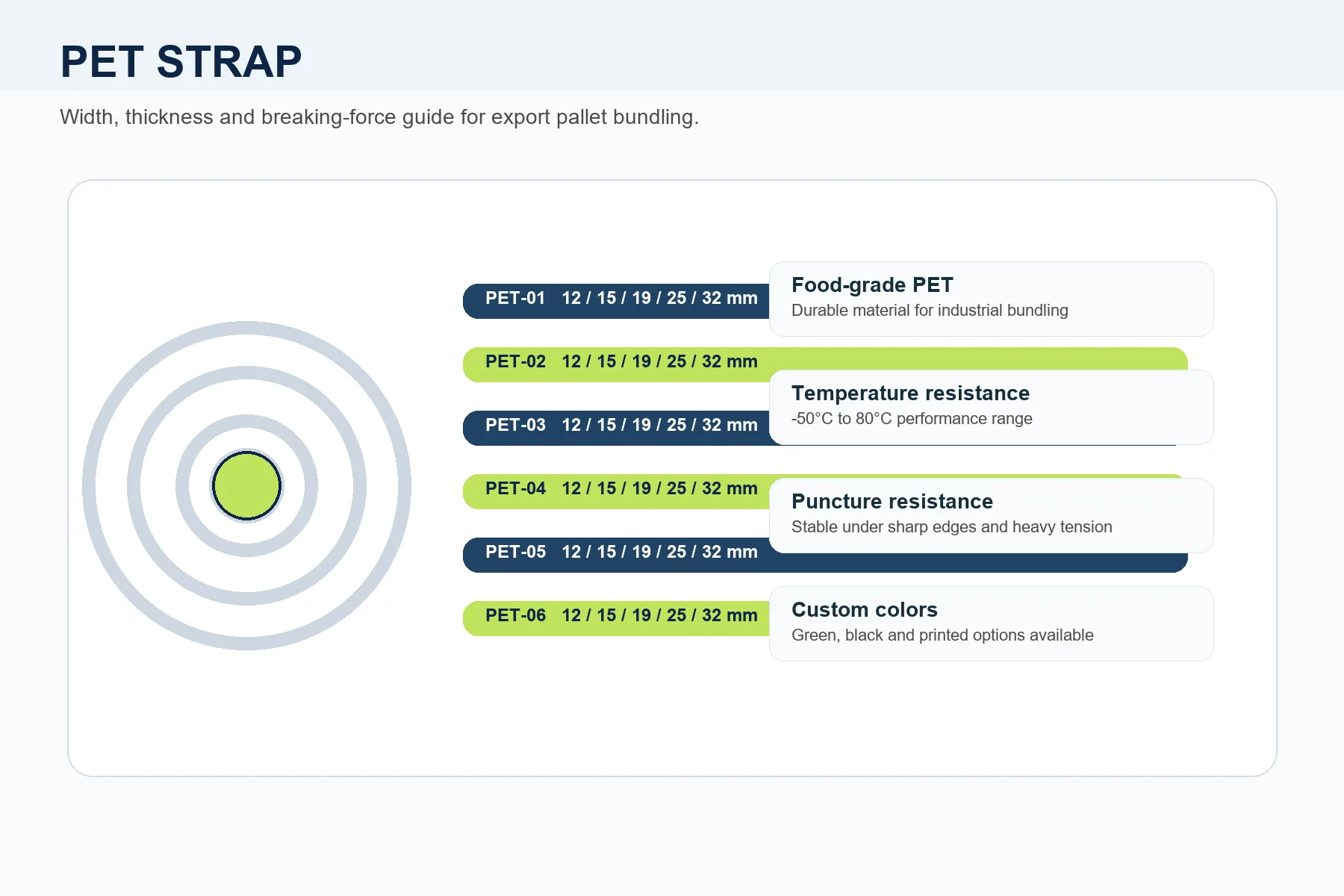
Start with the cargo, not the strap
The first step in choosing PET strap is to describe the cargo. A low, stable carton pallet does not need the same strap profile as a tall load of metal profiles or a bundle of construction materials. Textiles, solar components, bricks, pipes, and heavy industrial bundles each create different tension requirements. If the load can settle during transport, the strap must be chosen with enough margin to remain stable throughout handling, storage, and shipping.
A buyer who starts with the cargo can usually narrow the decision quickly. That is a better process than opening with price because the cheapest strap is only cheap if it performs correctly the first time. If it fails under stress, it costs more in rework, complaints, and damaged goods than the savings were worth.
What the main specifications mean
Width, thickness, weight per meter, roll length, and breaking force are the core data points. Width and thickness shape the strap’s physical presence. Weight per meter and roll length influence logistics and line efficiency. Breaking force is the most obvious indicator of how the strap will perform under tension. Buyers should ask for a data sheet and compare it against the load requirement rather than relying on appearance alone.
Width and thickness
Wider and thicker strap is usually preferred for more demanding applications, but not every heavy item needs the maximum size. The important thing is to choose a size that can be tensioned properly with the equipment in use. A well-matched medium size can outperform an oversized strap that is hard to apply consistently.
Breaking force and stability
Breaking force is a simple number, but it does not tell the whole story on its own. It should be evaluated together with stretch, puncture resistance, and the conditions in which the load will travel. A strap used on a shipping lane with high humidity, long dwell time, or repeated handling should be selected conservatively.
Surface style
Embossed strap can provide better grip and may be helpful for tensioning and load holding. Smooth strap can be preferred in some automatic systems or where a cleaner appearance is desired. The point is not that one is always better. The point is that the surface style should fit the packaging line and the customer requirement.
Manual, semi-automatic, and automatic use
PET strap is used in different ways depending on the plant. Some operations apply it manually with hand tools. Others use semi-automatic systems. Larger packaging lines use fully automatic equipment. These environments can require different roll behavior, friction characteristics, and consistency. Buyers should always ask whether the strap has been tested on the exact equipment or at least on the same machine family.
If the product is intended for machines, the supplier should be able to discuss compatibility in practical terms. That includes roll winding quality, edge consistency, and whether the strap maintains tension without frequent adjustments. Those small details often separate a smooth line from a frustrating one.
PET strap compared with steel and PP strap
Steel strap is still used in some heavy-duty cases, but PET is often preferred because it is lighter, easier to handle, and generally safer for operators. Compared with PP strap, PET usually offers stronger holding power and a better fit for export-grade pallet packaging. That is why PET has become the default choice for many industrial bundling jobs. It sits in the useful middle ground between cost and performance.
- Choose PET when the load needs strong bundling and safe handling.
- Choose steel only when the application genuinely requires it.
- Choose PP when the load is light and the budget is the main priority.
Climate and shipping conditions
Export packaging is exposed to temperature changes, humidity, storage delays, and handling impacts. PET strap should stay flexible enough to perform in cold conditions and stable enough to avoid cracking under real-world use. If a product is going to a humid port, a hot warehouse, or a cold inland route, those conditions should be part of the selection process. A good supplier will know how to discuss them without overpromising.
This is especially important when the strap is used with heavy loads that must remain intact for a long transit cycle. A small difference in strap consistency can create a big difference when hundreds of pallets are being shipped each month.
Why color and printing matter
Color is not just aesthetic. Some buyers need color coding across product lines, while others want branding or quick identification in the warehouse. Printed strap can also reinforce a customer’s packaging identity. That said, appearance should not replace technical specification. Color and printing matter when the mechanical requirements are already satisfied.
The same is true for custom colors. If a buyer wants green or black strap, or a branded printed version, the supplier should confirm that the production process will still preserve the required strength and roll quality. Decorative treatment should never compromise load holding performance.
Questions every buyer should ask
A good RFQ for PET strap should not stop at “send price.” Buyers should ask the supplier about available widths, thicknesses, breaking-force range, roll length, packaging method, and whether the product is better for manual or machine application. If the buyer is already using a strap, it helps to send the current sample or specification. That makes the conversation much more efficient and reduces the chance of mismatch.
- What are the available widths and thicknesses?
- Can you provide the breaking-force range for each option?
- Is the strap embossed, smooth, printed, or customizable?
- What equipment is it best suited for?
- How are rolls packed for export shipping?
How to test a sample correctly
When a sample arrives, the buyer should not just look at it. The strap should be tested under the same tensioning conditions it will face in production. If possible, it should be run on the same tools or machines, with the same load type, and with the same handling pattern. That is the best way to learn whether the roll quality is stable and whether the strap can really support the application.
A strong sample program will also include storage observation. If the strap will be kept for weeks before use, the buyer should look at how it behaves after sitting in the warehouse. Good packaging consumables are not only strong at the moment of opening. They stay dependable when the schedule gets messy, which it often does.
Common mistakes buyers should avoid
The most common mistake is choosing PET strap only by price and ignoring breaking force. Another mistake is buying the wrong width because the supplier catalog looked convenient. A third mistake is forgetting that the packaging line may use a machine that prefers a specific roll format. Buyers also sometimes underestimate climate exposure, which leads to performance surprises after the shipment reaches the destination market.
Good procurement is mostly about avoiding those surprises. A slightly longer selection process is worth it if it prevents a load failure or a machine stoppage later.
How SYTPACK positions the product
SYTPACK’s PET strap page shows that the company is serving industrial buyers rather than casual one-off orders. The product range includes multiple sizes, custom colors, different surface styles, and a wide set of application examples such as solar packaging, textile bales, metal bundles, concrete blocks, and more. That matters because it suggests the supplier is used to matching strap to real cargo types, not just filling a generic catalog page.
If you need a starting point, check the PET strap page and the contact page for custom sizing and quote requests.
FAQ
Is PET strap better than PP strap?
For many export and industrial applications, yes. PET typically offers stronger holding power and a better fit for heavier loads.
Can PET strap be used with machines?
Yes. The key is to confirm that the roll quality and dimensions match the machine type being used.
Does color affect performance?
Color itself should not, but the manufacturing process behind the color option must still meet the required mechanical performance.
What should buyers request first?
A data sheet, a sample, and a clear discussion of the actual cargo and equipment are the best starting points.
Conclusion
Choosing PET strap is less about picking a roll and more about matching an industrial consumable to a packaging system. When the buyer starts with the cargo, confirms the equipment, and checks the breaking-force requirement, PET strap becomes a dependable tool for export pallet packaging instead of a source of risk.
How to build a PET strap RFQ
A PET strap RFQ should read like a technical request, not only a price inquiry. The buyer should include the cargo type, target strap width, target thickness, expected breaking force, roll format, color, printing requirement, and equipment type. If the buyer is replacing an existing strap, sending the current specification or a small sample can save several rounds of clarification.
For machine use, the RFQ should also describe the machine type and operating environment. A strap that performs well with a manual tensioner may not behave the same way in an automatic system. Roll winding, edge consistency, and surface friction can affect machine stability. This is why buyers should ask for both technical data and practical application guidance before approving a bulk order.
- Cargo type and average pallet weight.
- Manual, semi-automatic, or automatic application method.
- Target width, thickness, color, and surface style.
- Required breaking force or current strap specification.
- Roll length, core size, carton packing, and pallet loading format.
- Expected route conditions, including cold storage, high heat, or long sea freight.
Quality control points during receiving inspection
After the shipment arrives, the receiving team should check more than carton quantity. They should inspect roll appearance, winding condition, color consistency, edge quality, and label information. A quick production trial is also valuable because strap performance is best judged under actual tension. If the strap is used by a machine, the receiving test should include machine feeding, tensioning, sealing, and cutting.
Buyers should keep a small retained sample from each order. This creates a reference if there is ever a performance dispute or reorder comparison. For ongoing programs, retained samples also help the packaging team notice whether a new batch has changed in hand feel, stiffness, color, or roll behavior. These small details can prevent bigger problems before the strap reaches the production floor.
Cost evaluation beyond the roll price
The lowest roll price is not always the lowest packaging cost. A strap that breaks more often, causes machine stops, or requires extra handling can quickly become more expensive than a stronger and more consistent product. Buyers should calculate total cost by looking at roll length, usable meters, breakage rate, operator efficiency, and load security. This is especially important for export orders where one failed pallet can cost far more than the difference between two strap quotations.
SYTPACK buyers can review the PET strap product page for size and customization direction, then send cargo photos or technical requirements through the contact page. That gives the factory enough information to recommend a strap that fits the shipment rather than simply quoting a generic roll.
Practical reorder planning
For repeat PET strap purchases, buyers should build a simple reorder plan instead of treating every order as a new negotiation. Keep the approved width, thickness, color, surface style, roll length, carton packing, and application method in one internal specification sheet. This helps the purchasing team, warehouse team, and supplier use the same reference when demand increases or when a new buyer takes over the account.
It is also useful to record monthly usage, safety stock, average lead time, and the production line where the strap is used. PET strap is a small item compared with the cargo it protects, but running out of the correct size can stop outbound shipments. A reorder plan protects the packaging workflow just as much as the strap protects the pallet.